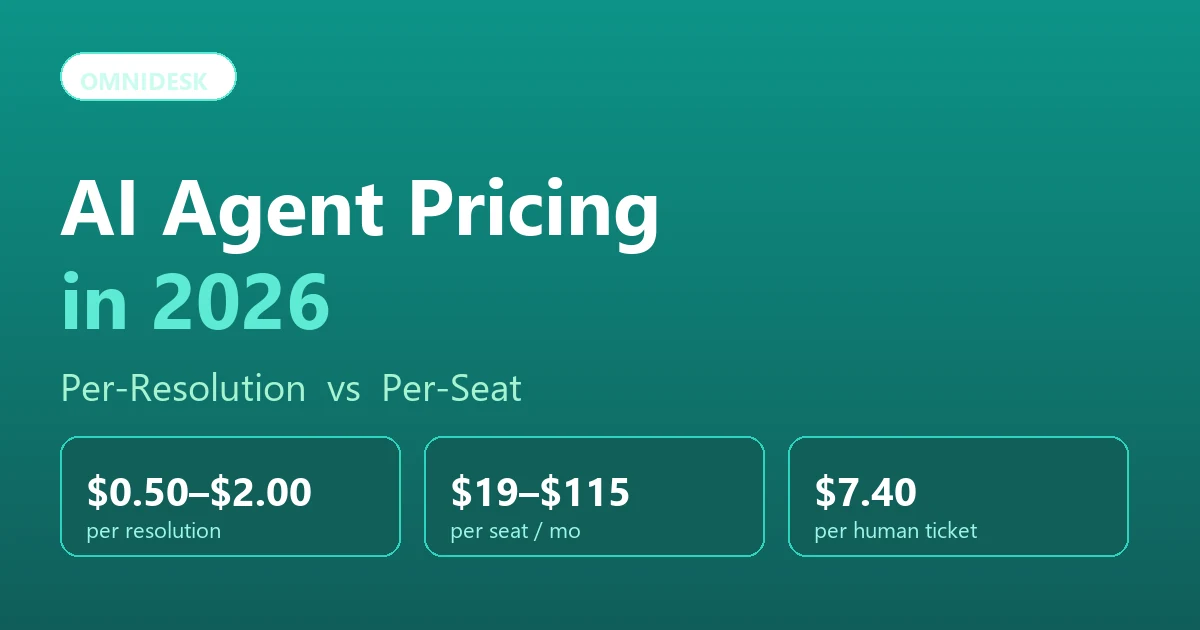
AI agent pricing in 2026 has settled into three models — per-seat, per-conversation, and per-resolution — and the gap between them is no longer academic. Published per-resolution rates from the major customer-service vendors run from $0.50 to $2.00, a 4x spread on what is nominally the same unit of value. The difference is rarely model quality. It is almost always the definition of the word resolution.
If you are budgeting support tooling for the next twelve months, this is the decision that moves the number most. Below is what each model actually costs, where the invoice diverges from the quote, and how to run the break-even calculation for your own volume before a sales call frames it for you.
The Three AI Agent Pricing Models, and What Each One Bills For
Per-seat charges a flat monthly fee for each human agent with a login. It is the legacy helpdesk model, and it is predictable: ten agents, ten seats, one invoice line that does not move when traffic spikes. The weakness is that it decouples cost from value entirely — you pay the same whether the AI resolved 50 conversations or 5,000.
Per-conversation charges for every inbound thread the AI touches, resolved or not. It is the least common of the three in 2026 because buyers pushed back hard on paying for failed attempts, though it survives as a hybrid layer inside several vendors' plans.
Per-resolution charges only when the AI closes a conversation end to end. This is the direction the market has moved, and it is the model most vendors now lead with in outbound. It aligns cost with outcome in theory. In practice, it hands the vendor the pen that writes the definition of the billable event.
What the Major Vendors Actually Charge in 2026
Here is where published AI agent pricing sits as of August 2026. Rates below are list prices; enterprise contracts routinely land 15–30% under list at committed volume.
| Vendor | Model | Published rate | Notes |
|---|---|---|---|
| Quickchat AI | Per-resolution | $0.50 | Low end of the published market |
| HubSpot Customer Agent | Per-resolution | $0.50 | Cut from $1.00 in April 2026 |
| Intercom Fin | Per-resolution | $0.99 | Best fit for teams already on Intercom Messenger |
| Zendesk AI Agents | Per-resolution + seats | $1.50–$2.00 | Billed on top of Suite seat licences |
| Salesforce Agentforce | Per-resolution | $2.00 | Top of the published market |
| Zendesk Support | Per-seat | $19 / $55 / $115 | Team / Professional / Enterprise per agent per month |
| Zendesk Advanced AI | Per-seat add-on | +$50 | Per agent per month, stacked on the plan above |
Two structural points matter more than any individual number. First, Zendesk's model is additive — per-resolution AI agent pricing sits on top of seat licences rather than replacing them, so a team migrating from seats to AI does not shed the seat cost. Second, at Relate in May 2026 Zendesk announced dual verification of billed resolutions alongside its Resolution Platform, which is a direct acknowledgement that buyers stopped trusting single-party resolution counting.
The Break-Even Math: When Per-Resolution Beats Per-Seat
The calculation is simpler than vendor ROI calculators make it look. Divide your fully loaded seat cost by your blended per-resolution rate to get the number of AI-resolved conversations per agent per month at which the two models cost the same.
| Seat cost / agent / mo | At $0.99 / resolution | At $1.50 / resolution | At $2.00 / resolution |
|---|---|---|---|
| $19 (entry) | 19 resolutions | 13 resolutions | 10 resolutions |
| $55 (professional) | 56 resolutions | 37 resolutions | 28 resolutions |
| $115 (enterprise) | 116 resolutions | 77 resolutions | 58 resolutions |
| $205 (fully loaded mid-market) | 207 resolutions | 137 resolutions | 103 resolutions |
Read the table as a threshold, not a recommendation. Below the break-even count, per-seat is cheaper because you are paying for capacity rather than usage. Above it, per-resolution AI agent pricing scales with demand and you stop funding empty seats through slow months. For most teams under roughly 1,500 conversations a month, per-seat still wins on raw cost — which is worth knowing before you are sold an outcome-based contract you will not clear the threshold on.
The comparison against human cost is more decisive than the comparison between models. AI resolutions average $0.62 per chat ticket and $1.18 for voice, against a human-agent average of $7.40 (McKinsey, AI in Customer Service 2026). That is an 85–90% reduction per eligible ticket — and "eligible" is carrying real weight in that sentence, which brings us to the number most models get wrong.
Do Not Build Your Model on Deflection Rate
This is the single most common error in AI agent pricing forecasts. Deflection counts any conversation that never reached a human — including customers who gave up and left. Resolution counts only issues closed end to end. The two differ by 20 to 40 points, and vendors quote whichever is flattering.
Realistic 2026 resolution ranges to model against:
- 30–50% — early deployment, first 90 days, limited intent coverage
- 50–70% — mature workflows with tuned intents and clean escalation paths
- 70–85% — deeply integrated, action-taking agents on well-scoped use cases only
For context on the deflection side of the ledger: median tier-1 deflection sits at 41.2% across enterprise CX programmes in 2026, with the top quartile at 58.7% (Zendesk CX Trends; Salesforce State of Service). Our own breakdown of how small teams reach 30–70% deflection covers the intent-level work required to move those numbers — and it is the same work that determines whether per-resolution pricing pays off.
Gartner's research adds a useful reality check on maturity: 64% of enterprise CX teams ran an agentic AI pilot in 2026, but only 27% had a channel in full production. Model your first year against pilot economics, not the production case study in the vendor deck.
Where the Hidden Costs Live in AI Agent Pricing
Four patterns account for most of the gap between quoted price and actual invoice.
1. Double billing on the same conversation. Some vendors charge a per-resolution AI fee and a per-ticket helpdesk fee for a single AI-handled conversation. Gorgias is the most-cited example: a $360 Pro plan can reach $960 once automation hits the rate the vendor's own marketing promotes. The higher your automation, the worse the arithmetic gets — which inverts the incentive the pricing model was supposed to create.
2. Add-on stacking. Copilot, quality assurance, workforce management, and the AI add-on are separate line items at most enterprise vendors. Once stacked, mid-market teams land between $165 and $265 per agent per month — a long way from the $19–$55 headline that opened the conversation.
3. The resolution definition itself. Most per-resolution vendors mark a resolution when the customer does not reply or reopen within a window after the AI's last message. A customer who abandons in frustration bills identically to one who was genuinely helped. Tie billing to a fuzzy event that scales with traffic and an outage or a viral moment spikes your invoice at exactly the moment your service is worst.
4. Volume variance. Per-seat is flat; per-resolution is not. Budget the ceiling, not the average. If your December volume is 2.4x your July volume, your December AI agent pricing line is 2.4x too.
Five Questions to Ask Before Signing
- How exactly do you define a billable resolution? Get it in the contract, not the FAQ page. A vendor-set heuristic is a conflict of interest however well-intentioned — the party defining what you pay for is the party you pay.
- Can I audit the resolution log? Line-item visibility into every billed resolution, exportable, with the conversation attached.
- Are disputed resolutions credited back? And what is the dispute window? Thirty days is standard; some vendors offer none.
- Is the AI fee additive to seats or a replacement? Zendesk's is additive. Assume additive unless the contract says otherwise.
- Which channels count separately? WhatsApp Business API messaging fees, voice minutes, and SMS are frequently billed outside the AI agent pricing line entirely.
The WhatsApp Wrinkle Most MENA Teams Miss
Conversation-shaped billing was designed around email and web chat. WhatsApp does not behave like either. Threads are short, high-frequency, and often stretch across hours or days — so a single customer issue can generate several billable sessions under some vendor definitions while counting as one ticket in an email-shaped model.
If WhatsApp is your primary channel, ask whether a resolution is scoped to the conversation window or the customer issue, and confirm whether Meta's own conversation charges pass through separately. Teams running multiple WhatsApp numbers from one dashboard should also check whether AI agent pricing is metered per number or per workspace — the difference compounds fast across a five-number setup.
This is also where a per-seat model quietly holds up better than the spreadsheets suggest. High-frequency, low-complexity WhatsApp traffic produces a lot of billable events per resolved issue, and a well-run shared inbox with routing rules and canned responses handles a meaningful share of it without invoking an AI resolution at all.
How to Choose in a Single Afternoon
Pull your last 90 days of conversations and count them. Estimate your realistic resolution rate from the ranges above — use 35% if you are starting fresh, not the 70% in the case study. Multiply, then compare against your fully loaded seat cost including every add-on you would actually enable.
If you land below break-even, take the seat model and revisit in two quarters. If you land above it, negotiate the resolution definition harder than the rate — a $0.99 rate on a generous definition costs more than $1.50 on a strict one. And whichever model you pick, instrument the metrics that show whether quality held. AI agent pricing that halves your cost per ticket while dropping CSAT by half a point has not saved you anything.