WhatsApp Automation Seasonal Spikes: The 2026 Peak-Season Playbook
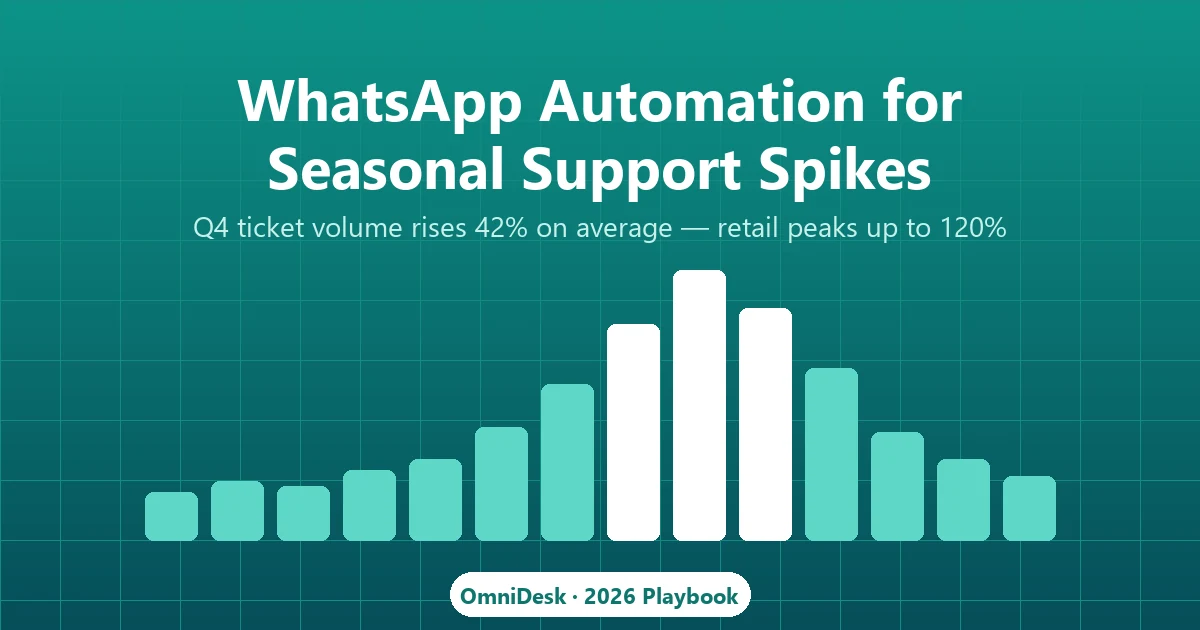
Q4 support volume rises 42% on average and up to 120% in retail — and the date it happens has been on your calendar all year. Here is the six-week runway, the four question types worth automating, and the freeze rules that keep peak week boring.
Every support team knows the shape of the curve. Volume climbs through November, detonates over Black Friday and Cyber Monday, holds through the shipping-cutoff panic in mid-December, and collapses in January. What separates the teams that come out of it with intact CSAT from the ones that come out of it with resignations is not headcount. It is how much of that curve was absorbed by automation that was built, approved and tested before the traffic arrived.
This is a planning problem disguised as a capacity problem. WhatsApp automation seasonal spikes work only when the flows, the templates and the escalation rules are already live and already measured at normal volume. Below is what the data says the spike looks like, what to automate, when to build it, what it costs at 2026 per-message rates, and what to leave alone once the week starts.
The Spike Is Bigger Than Most Teams Budget For
Zendesk Benchmark data puts the average Q3-to-Q4 increase in support ticket volume at roughly 42% across industries. That average hides the retail reality. Retailers report increases of up to 120% across Black Friday and Cyber Monday, and e-commerce brands routinely run at three to five times normal volume between Black Friday and Christmas, with the sharpest promotional moments producing surges of 5–10x. Helpshift's performance index recorded the single busiest day for online-only brands at 129% above the non-holiday baseline.
Two second-order effects matter as much as the headline number. First, the channel mix shifts — during peak weeks the split between synchronous chat and asynchronous messaging moves sharply toward whatever queue can be batched, which changes the staffing model mid-week. Second, tickets per agent still rise by 17% or more even after seasonal hiring, because onboarding a temporary agent takes longer than the spike lasts. That second number is the whole argument for automation: you cannot hire your way to a curve that peaks in nine days.
Automate the Four Question Types, Not the Whole Inbox
Peak-season inbound is unusually concentrated. Four categories carry most of the volume, and all four are high-frequency, low-variance and answerable from data you already hold:
Order status and tracking (WISMO). The single largest bucket in every retail peak. Fully automatable against your order system.
Delivery timing and cutoff dates. "Will it arrive by the 24th?" Answerable from a courier SLA table plus the customer's emirate, city or postcode.
Returns and exchange windows. Peak-season policies usually differ from standard ones, which is exactly why customers ask.
Stock and promotion terms. Whether a code stacks, when a price drops, what is left in a size.
A well-built WhatsApp flow on these four can deflect 60–80% of tier-one volume. Rule-based bots that only pattern-match text handle 40–50% of inbound cleanly and create friction on the rest, which is the practical case for pairing a decision-tree flow with an AI deflection layer that can read a message it has not seen before.
Just as important is what stays human. Refunds already issued, damaged or missing goods, anything with a legal or safety edge, and any message where the customer is visibly angry should route straight to a person. A bot that argues with an upset customer on Black Friday costs more in review damage than the ticket ever cost in salary.
Build on a Six-Week Runway, Not a Six-Day Scramble
The most common failure is not building the wrong automation — it is building the right automation too late to test it. WhatsApp message templates require Meta approval, and a rejection costs days you will not have in November.
Week out
What happens
Why it must be this early
Week 6
Pull last year's peak tickets, cluster by intent, pick the top 5 flows
You are automating the questions you actually got, not the ones you imagine
Week 5
Draft and submit WhatsApp templates for approval
Approval is not instant and rejections need a resubmission cycle
Week 4
Build the flows and connect them to order and stock data
Integration bugs surface here, at zero traffic cost
Week 3
Write routing and escalation rules; define the handoff message
Escalation logic is what fails first under load
Week 2
Run live on real traffic at normal volume; fix what breaks
Normal volume is the only safe place to find the edge cases
Week 1
Freeze. Brief the team. Staff the rota.
Nothing ships into peak week untested
If you are inside six weeks right now, cut scope rather than the runway: two flows tested beat five flows shipped blind. The template approval process is the hard dependency in that schedule, so it moves first regardless of how much else gets dropped.
Proactive Utility Messages Are the Cheapest Spike Control You Have
The cheapest ticket is the one never sent. Proactive order update messages on WhatsApp — dispatched, out for delivery, delayed — remove the WISMO question before the customer thinks to ask it, and they are billed as utility rather than marketing.
The billing basis matters more than it used to. WhatsApp retired conversation-based pricing on 1 July 2025 and now bills per template message, priced by recipient country and category. Representative 2026 marketing rates run from roughly USD 0.0103 in India to USD 0.025 in the United States, with the UK near GBP 0.038 and Germany above EUR 0.11. Utility rates sit well below marketing rates in the same market, and volume tiers pull them lower again. One further change belongs in any peak budget built now: from 1 October 2026, Meta plans to charge per business message including service replies sent inside the 24-hour window, which removes the free-reply cushion that current peak models quietly assume.
Run the arithmetic before the season, not after the invoice. A brand sending 40,000 proactive utility updates through a peak month is looking at a line item measured in low hundreds of dollars — against a WISMO deflection that would otherwise have consumed hundreds of agent-hours.
Peak season starts in weeks, not months. Get your WhatsApp flows, routing and SLA rules live while there is still time to test them.
Set the Escalation Rule Before the Spike, Not During It
Automation does not remove humans from peak season; it decides which conversations reach them. Plan for a 20–35% human escalation rate with an LLM-based agent and materially higher with a rule-based bot. Then plan for the top of that range, because a spike changes the traffic mix: more first-time buyers, more gift purchases going to third-party addresses, more emotionally loaded messages about things that must arrive by a date.
Three rules should be written down and agreed before the first surge day:
The trigger. Escalate on sentiment, on a second failed containment attempt, or on any keyword in your hard-stop list — not on a fixed number of turns.
The destination. Every escalation needs a named queue with a staffed rota behind it. Routing rules that point at an empty queue are worse than no automation at all.
The handoff. The human must receive the full transcript and the order context. Making the customer repeat themselves after a bot has already failed them is the moment peak-season CSAT dies.
Set your SLA thresholds for the peak window explicitly and separately from your normal ones. A first response target that is honest at 4x volume beats an aspirational one that the whole team quietly stops believing in on day two.
Watch Five Numbers Daily, Not Twenty
Peak week is not the time for a dashboard review. Five numbers, checked once each morning, tell you whether the plan is holding:
Metric
What it tells you
Act when
Containment rate
Share of conversations closed without a human
Drops more than 10 points below your week-2 pilot
Median first response time
Whether the queue is actually moving
Exceeds your declared peak SLA two days running
Escalation queue depth
Whether humans are the new bottleneck
Depth grows across a full shift
CSAT on automated threads
Whether you deflected or actually resolved
Sits more than 5 points under human-handled threads
Repeat contact rate
Whether the bot's answer held
Rises above your baseline at all
Containment on its own is the number most likely to mislead you, because it counts the customer who gave up identically to the one whose problem was solved. Read it next to CSAT and repeat contact rate or not at all. The same caution applies to first response time benchmarks — a fast automated acknowledgement that resolves nothing will flatter the metric while the backlog grows behind it.
Freeze Week Is a Feature, Not Caution
In the seven days before the spike and through the peak itself, five things do not change: template content, routing logic, SLA thresholds, knowledge base structure, and platform. Peak week is the worst possible moment to discover that a rewritten template failed re-approval, or that a new rule sends a queue somewhere nobody is watching.
Three changes remain safe and should stay available: editing the variable content inside an already-approved template, adding agents to an existing queue, and switching a misbehaving automation off. Everything else waits for January. Write the freeze list down and give one named person the authority to enforce it, because under load the pressure to "just quickly fix" something is enormous and almost always wrong.
The Cost Case, Honestly Stated
Take a mid-sized retailer running 8,000 support conversations in a normal month and 28,000 in peak month. Without automation, at a conservative 12 conversations per agent-hour, that peak month needs roughly 2,300 agent-hours — several seasonal hires who each need onboarding that outlasts the season.
With the four core flows live and a realistic 65% containment on tier-one volume, the human-handled remainder falls to around 11,000 conversations, or roughly 900 agent-hours. Against that saving sits the messaging bill: proactive utility updates and template sends across the month, priced at the per-message rates above, plus your platform subscription. In every version of this arithmetic we have seen at MENA volumes, the messaging line is a rounding error next to the labour line — but only if containment is real. At 30% containment, which is what an untested flow shipped in week one delivers, the case is much weaker and the CSAT cost is real.
That is the honest version: WhatsApp automation seasonal spikes math works decisively in your favour when the flows were tested at normal volume six weeks earlier, and only marginally when they were not.
Run the Debrief While the Data Is Still Warm
In the first week of January, before anyone forgets, pull the peak window and compare it against the same window last year on four axes: containment, median first response time, CSAT split by automated versus human, and cost per contact. Then export every conversation the automation escalated and cluster them by intent. That cluster list is next year's build backlog, and it is the single most valuable artefact the season produces.
Teams that do this compound. The fifth flow you build is cheaper than the first, the templates are already approved, and the runway shortens because the intent clustering is already done. Teams that skip it rebuild from memory every October and wonder why peak week never gets easier. If burnout showed up in the debrief as well as volume, the structural fixes in our guide to running support without burning the team out are the right place to start.
Frequently Asked Questions
How much does support volume actually rise during a seasonal spike?
Across industries, ticket volume rises roughly 42% between Q3 and Q4 on Zendesk Benchmark data. Retail is far steeper: up to a 120% increase across Black Friday and Cyber Monday, and three to five times normal volume between Black Friday and Christmas. Helpshift's index put the busiest single day for online-only brands at 129% above the non-holiday baseline. Tickets per agent still rise about 17% even after seasonal hiring — which is why WhatsApp automation seasonal spikes planning starts with deflection rather than headcount.
Which WhatsApp questions are worth automating before peak season?
Four categories carry most of the volume: order status and tracking, delivery timing and cutoff dates, returns and exchange windows, and stock or promotion terms. All four are high-frequency, low-variance and answerable from data you already hold, which is why a well-built flow can deflect 60–80% of tier-one volume. Refunds already issued, damaged goods, and any visibly angry customer should route to a human immediately instead.
When should I start building automation for a seasonal spike?
Six weeks out. Weeks 6–5 are for pulling last year's ticket data and drafting templates, because WhatsApp templates need Meta approval and rejections cost days. Week 4 builds and tests flows, week 3 sets routing and escalation, week 2 pilots on real traffic at normal volume, and week 1 is a freeze. Teams that start six days out ship untested flows into their highest-traffic week of the year.
What does WhatsApp automation cost per message during peak?
WhatsApp moved from conversation-based to per-message billing on 1 July 2025, so every template message is billed individually by recipient country and category. Representative 2026 marketing rates run from about USD 0.0103 in India to USD 0.025 in the US, with the UK near GBP 0.038 and Germany above EUR 0.11. Utility messages — order confirmations, shipping updates — are billed at a fraction of marketing rates. Budget carefully for 1 October 2026, when Meta plans to charge for business messages including service replies inside the 24-hour window.
What escalation rate should I plan for when automation handles peak volume?
Plan for 20–35% human escalation with an LLM-based agent, and materially higher with a rule-based bot, since rule-based flows handle only 40–50% of inbound cleanly. Model the top of the range for peak weeks: spikes bring more first-time buyers, more edge cases and more emotionally charged messages than your normal traffic mix. Staffing to the optimistic number is the most common way a peak plan fails in its second week.
What should I avoid changing during peak week itself?
Freeze template edits, routing logic, SLA thresholds, knowledge base restructuring and any platform migration. Peak week is the worst time to discover a rewritten template failed re-approval or that a new routing rule sends a queue nowhere. The only safe live changes are editing variables inside an already-approved template, adding agents to an existing queue, and turning a broken automation off.
How do I measure whether the automation worked after the spike?
Compare four numbers against the same window last year: containment rate, median first response time, CSAT on automated versus human conversations, and cost per contact. Containment alone misleads because it counts customers who gave up. If CSAT on automated threads sits within a few points of human-handled ones and first response time held under your peak SLA, the automation earned its place. A sharp CSAT drop means you deflected volume rather than resolving it.
Go into peak season with the flows already tested.
Join 500+ businesses using OmniDesk to manage WhatsApp, Instagram, Telegram and live chat — with AI auto-reply, routing and SLA tracking included.